

Everyday, i ask myself the same question: how can I help public decision-makers ensure energy security, economic attractiveness, and environmental security for their cities? Recent crises have revealed the fragility of our energy supplies and the urgent need to rethink our models. Heating represents one of the greatest challenges in urban energy consumption, accounting for a significant share of cities' energy needs.
Persistent dependence on fossil fuels exposes our cities to major risks: price volatility, growing energy poverty, rising CO₂ emissions. While debates often focus on renewable electricity, I observe that conventional solutions are no longer sufficient. It is time to turn local resources into strategic assets. This is why I am convinced that urban district heating networks represent a concrete and innovative solution, capable of accelerating cities' energy transition, strengthening their resilience, and strengthening their energy independence .
Through a locally adapted energy mix , leveraging biomass, geothermal energy, waste heat, and other local resources, these long-term local infrastructure enable the decarbonization of heating and cooling while guaranteeing affordable and stable energy for all.
Key points to remember
- Heat accounts for 50% of final energy consumption in Europe, and nearly 70% of this demand still depends on fossil fuels.
- The urban district heating network brings together of local resources (biomass, geothermal energy, industrial waste heat, data center waste heat, heat recovered from wastewater and treatment plants, heat produced from non-recyclable waste) to deliver reliable and affordable energy.
- The unique combination of Veolia's expertise in water, waste, and energy sectors enables the design of ultra-efficient circular economy loops at the heart of communities.
- Veolia's innovative Ecothermal Grid offering provides a direct path toward carbon-neutral, intelligent networks designed for small and medium-sized cities.
Let us explore how communities that have invested in urban district heating networks have gained: energy independence, more predictable energy costs, and accelerated energy transition.
How do urban district heating networks transform your cities?
The reality on the ground: traditional solutions are no longer sufficient
The reality on the ground demands tailor-made solutions. Traditional energy models, built around imported fossil fuels, now show their limitations: vulnerability to external shocks (particularly geopolitical), cost volatility, increased dependence on foreign suppliers, and inability to meet climate requirements. The 2022 energy crisis reminded everyone of the importance of local, stable, and resilient production. Heating accounts for 50% of final energy consumption in Europe, and 70% of this demand still depends on fossil fuels. This dependence weighs on the energy security of cities and all their stakeholders, even as cities' energy transition becomes imperative to address the climate emergency.
Towards Territorial Energy Mix
Faced with these challenges, urban district heating networks (or district heating) offer a strategic solution. In practice, it is a system for distributing heat produced centrally and conveyed as hot water through buried pipes to serve multiple buildings. To successfully achieve cities' energy transition, we must rethink our approach and adopt a diversified local energy mix. This concept involves mobilizing and combining all renewable energy sources available locally: geothermal energy (heat from the subsoil), biomass (green waste, wood waste, etc.), as well as the recovery of "waste heat" (residual heat produced by industrial processes, data centers, or sanitation systems, incinerators, etc., which, if not used, is released into the atmosphere). By centralizing and making better use of these resources that are literally beneath our feet or around the corner, district heating networks enable the recover energy that would otherwise be lost – waste heat from an industry, data center, or incinerator – and distribute it efficiently to residents. With an average efficiency of 88% for Veolia networks, this approach minimizes distribution losses and offers increased resilience to cities and their inhabitants.
Veolia's integrated approach: the power of local circularity
The uniqueness of Veolia's approach lies in our ability to orchestrate all solutions in an integrated manner. By combining our three core businesses, water, waste, and energy, we have the capacity to create unique industrial synergies where the activity of one directly feeds into that of another.
This unique capability enables us to transform sewage sludge into biogas, household waste into heat, or waste heat from wastewater into energy for public and residential buildings. We are not promoters of a single technology; we adapt rigorously to the context of each living area.
It is this holistic approach that makes the difference and enables us to support each community in building a resilient, competitive, and decarbonized energy model.
The figures speak for themselves: Veolia operates 494 district heating and cooling networks worldwide, serving nearly 7 million inhabitants, primarily in Europe (though limited presence in France). Furthermore, to meet the needs of small and medium-sized cities, as well as private facilities (campuses, hospitals, airports, etc.), we have developed the innovative Ecothermal Grid offering. This solution, which we will present in detail in a dedicated article, combines different sources of renewable and local energy, while integrating storage and intelligent management to guarantee reliability and flexibility.
« Decarbonizing heat is not an objective, it is an essential transformation. With decades of experience, from phasing out coal to AI-driven optimization, Veolia is leading the transition toward sustainable urban heat. Our ambition becomes action, powering cleaner, smarter, and more sustainable cities. »
Estelle Brachlianoff, Chief Executive Officer of Veolia
Download our New Urban Energy presentation to understand how Veolia supports the energy transformation of European cities.
Communities that have made their energy transformation with Veolia
Concrete examples are often the best arguments. Here are some achievements that allow me to demonstrate concretely what the transformation of an urban district heating network can bring to a community:
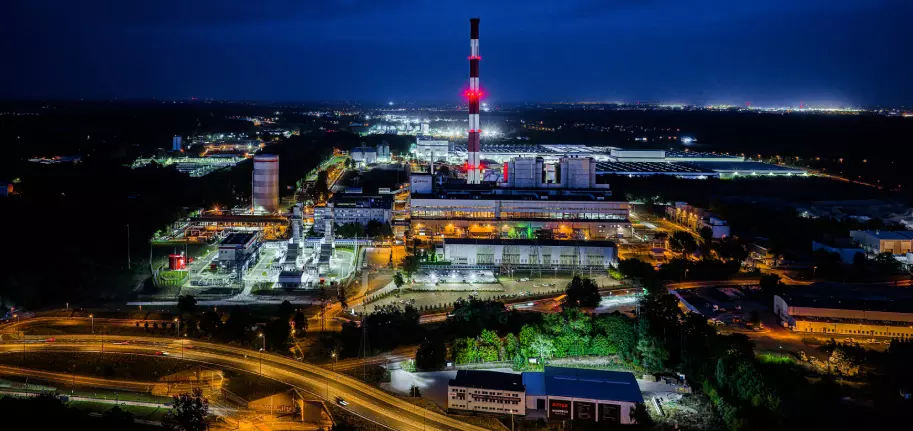
- In Poznań (Poland): We recover waste heat from the Volkswagen foundry to heat 6,500 households. Furthermore, our transformation plan for the coal-fired power plant that supplies the urban district heating network toward a mix of gas, biomass, and residual heat will reduce CO2 emissions by 60% by 2030.
- In Brunswick (Germany): We have implemented a cogeneration unit operating 100% on wood waste from a wood waste treatment plant built by Veolia in the immediate vicinity. A perfect local loop.
- In Budapest (Hungary): We produce heat and cold from the wastewater treatment plants we operate to supply hospitals and universities.
- In London (United Kingdom): We heat 5,000 households using energy produced by the city's waste treatment facilities.
- In Paris-Saclay (France): Veolia has operated since 2023 Europe's first 5th generation district heating and cooling network, combining deep geothermal energy, waste heat from the CNRS supercomputer, and cold network recovery with the objective of exceeding 100 GWh/year of heat by 2028.
In each case, the key to success lies in adapting the solution to the local context, mobilizing the community's resources, and providing customized support by Veolia teams. These examples illustrate the diversity of possible approaches, whether for small towns or large urban areas, and the ability to generate concrete, measurable, and sustainable results.
Financing, regulation, and action plan: securing your energy transition project
Urban district heating networks: what you need to know about European regulations and financial assistance
It is natural that for an elected official or a general manager of services, the question of financing is often the first to be raised. Transforming or developing an urban district heating network represents a significant investment, but one that is economically viable, with measurable and sustained returns supported by robust public mechanisms.
Implementing such a project requires a long-term economic vision and perfect mastery of the regulatory framework. At the European level, the Energy Efficiency Directive 2023/1791 and the Union's climate objectives impose energy consumption reductions of 11.7% by 2030 and ambitious targets for integrating renewable energies into heating and cooling systems. These progressive criteria for renewable energies or waste heat apply from 2027, evolving toward 100% by 2050.
For communities, these regulatory constraints transform into major financing opportunities: national subsidies, cogeneration support mechanisms, and guarantee funds for geothermal energy.
How can you make this project a reality? Several financing approaches exist. Local authorities, eco-district developers, or external partners can undertake this investment. In the latter case, the third-party financier assumes the initial cost in exchange for a multi-year infrastructure operation contract, often within the framework of a public service delegation. Simultaneously, communities can access substantial aid: regional, national, and European subsidies specifically dedicated to the development of thermal networks.
To ensure the success of your initiative, expert support is essential. Our proven expertise in asset management and large-scale decarbonization ensures reliable execution, cost optimization, and sustainable value creation for your community. We support you at every stage: diagnosis, design, financing, operation, and performance monitoring.
Action plan for initiating your community's energy transformation
Given the scope of the subject, the practical question often comes down to: "Where do we start?" To engage your community in this transition, I propose a pragmatic and structured approach:
- Conduct a comprehensive energy diagnosis of your community to identify local resources and specific needs.
- Define an locally adapted energy mix, integrating biomass, geothermal energy, waste heat, waste, and renewable energies.
- Choose the most relevant partnership model (concession, PPP, delegated management) to secure financing and performance.
- Mobilize available public aid mechanisms (subsidies, guarantee funds, support mechanisms) to optimize your financing.
- Ensure compliance with regulatory obligations from the design phase of your project.
- Rely on an experienced partner for the design, implementation, operation, and monitoring of your urban district heating network.
- Deploy or transform an existing urban district heating network: flexible, scalable, and connected, guaranteeing performance, resilience, and attractiveness.
Toward local, decarbonized, and accessible energy for all
By investing in high-performance urban district heating networks, you are making far more than a technical choice: you are securing your residents' energy supply, controlling costs, and creating local value. It is also local and affordable energy, a measurable reduction in your carbon footprint, a source of electrical flexibility and revenue – this is what this transformation can concretely bring to your community.
In essence, an urban district heating network embodies a new vision of energy: local, decarbonized, and accessible.
And to go even further, Veolia has an innovative solution specifically designed for small and medium-sized urban district heating networks: the EcoThermal Grid offering. By combining renewable energies, waste heat recovery, heat pumps, electric boilers, and AI-driven digital tools, this offering promises to maximize efficiency, reduce emissions, and deliver sustainable and profitable energy, whether you are a municipality, private operator, or campus. From identifying renewable sources to deploying and optimizing networks, Veolia positions itself as a key player across the entire value chain. We’ll explore this solution in greater detail in a future article.
At Veolia, we have the conviction and experience that this transformation is possible, everywhere, at all scales. I invite you to take the step.
This article contains text partially generated with the assistance of generative artificial intelligence, based on the Group’s knowledge base. The content has been reviewed and validated by the expert.