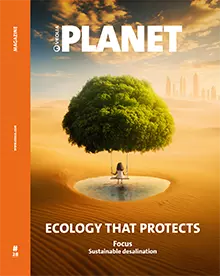
As heatwaves intensify across Europe, Veolia is deploying its Water Security offering to help communities protect their water resources for the long term.
France is experiencing its third heatwave of the season. Across Europe, recurring droughts and mounting pressure on water resources are becoming the new normal. Water is now at the heart of how communities adapt to climate change. For local authorities, the challenge is no longer simply managing crises as they arise, but anticipating them to ensure long-term access to an increasingly fragile resource.
Because water security is a cornerstone of environmental security, Veolia develops solutions that help communities anticipate the impacts of climate change and sustainably protect natural resources.
That is precisely the ambition behind Water Security, Veolia's comprehensive offering designed to help communities safeguard their water resources. Combining expertise, innovation, and practical solutions, Water Security supports local authorities in adapting to a new climate reality.
Anticipating water stress before it becomes a crisis
Extreme heat accelerates evaporation, reduces river flows, weakens groundwater reserves, and intensifies competition among different water users. As these trends accelerate, traditional water management models are reaching their limits.
Through its Water Security approach, Veolia helps local authorities anticipate future challenges by conducting detailed risk assessments at both watershed and regional levels. This approach takes into account the needs of different water users, environmental constraints, climate projections, and existing infrastructure to develop resilience strategies tailored to each local context.
The objective is clear: ensure a reliable long-term water supply while preserving natural resources.
Watch the documentary "The Future of Water: Accelerating Change"
Building a true "water mix"
There is no single solution to water scarcity. Just as the energy transition relies on a diversified energy mix, Veolia advocates for a water mix—combining multiple complementary solutions tailored to the needs of each territory.
Protecting drinking water sources, reducing network water leakage, implementing predictive monitoring, optimizing infrastructure, promoting water conservation, preserving aquifers, improving stormwater management, diversifying water sources as desalination, and reusing treated wastewater all contribute to strengthening communities' resilience to droughts and extreme heat.
This integrated approach also helps balance competing water uses while protecting ecosystems and biodiversity.
Supporting communities in their decision-making
Beyond technical solutions, Water Security is built on a collaborative methodology that brings together all stakeholders across a territory.
Veolia helps local authorities assess their vulnerabilities, prioritize investments, and develop roadmaps tailored to local realities. This process involves water agencies, government authorities, businesses, farmers, and citizens in creating shared governance of water resources.
Because water security is no longer simply about managing water networks—it has become a strategic issue for regional planning and development.
Water reuse: a key lever for the future
Among the solutions deployed, treated wastewater reuse is expected to play an increasingly important role in regions facing water stress. Today, only 2.4% of treated wastewater is reused within the European Union, even though nearly half of Europe's river basins could experience water stress by 2030.
Veolia has already implemented water reuse projects in several countries, including the landmark Jourdain Program, developed in partnership with Vendée Eau. One of Europe's pioneering demonstration projects, Jourdain showcases how water reuse can complement conventional water resources while maintaining the highest public health and safety standards.
For Veolia, however, treated wastewater reuse is not a one-size-fits-all solution. It is one component of a broader, sustainable water resource management strategy adapted to the specific characteristics of each watershed.
Recognizing the strategic value of water
One of today's greatest challenges is better understanding the true cost of water shortages. To address this, Veolia is developing an innovative Cost of No Water methodology, helping both public and private decision-makers assess the economic, social, and environmental consequences of water scarcity. This tool is designed to support smarter investment decisions and accelerate resilience measures before crises occur.
The cost of not having water remains largely invisible.

As heatwaves become more frequent and more intense, protecting water resources is no longer simply about responding to droughts. It is about anticipating risks, planning ahead, and investing in solutions that strengthen long-term resilience. That is the ambition behind Veolia's Water Security offering: helping communities make water a cornerstone of environmental, economic, and social security.
Water Security: key figures
- 2.4% of treated wastewater is currently reused across the European Union.
- 50% of Europe's river basins could experience water stress by 2030.
- 2.2 billion people still lack access to safely managed drinking water.
- Up to €1 million: the potential cost of just one hour of production downtime caused by water shortages in certain strategic industries.
- Up to 4× return on investment: the potential ROI of more resilient water infrastructure, according to the OECD.
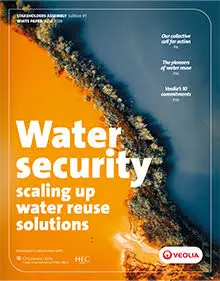
Water security