


As France approaches its 2027 presidential election, Antoine Frérot, chairman of Veolia, is publishing a book with Flammarion, titled “De l'entreprise en démocratie”, examining the excesses of financial capitalism. He argues for a vision of business built on a long-term perspective, shared decision-making and consideration of all stakeholders.
Must capitalism reform itself to ensure its own survival? This is the central question raised in Antoine Frérot’s book, published late October 2026. In the book, the Veolia chairman reflects on contemporary capitalism, which he believes is characterized by the dominance of shareholders, the pursuit of immediate profits and the growing financialization of businesses.
At a time when purchasing power, the green transition, taxation and working conditions feature prominently in public debate, Antoine Frérot wants to put business back at the center of economic and political thinking. His ambition is clear: to preserve capitalism by correcting its excesses.
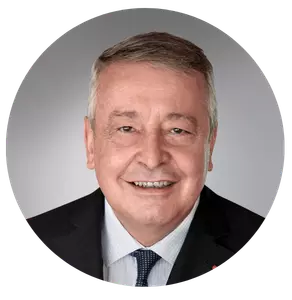
« Capitalism may well be sawing off the branch on which it is sitting »
Antoine Frérot, Chairman of Veolia.

Thirteen Leaders, Thirteen Perspectives on Business
To further develop his thinking, Antoine Frérot also brings together thirteen individuals from a wide range of backgrounds, engaging them in discussions that challenge his analysis and convictions. They include economists such as Philippe Aghion; labor union leaders such as Sophie Binet and Marylise Léon; business executives such as Philippe Brassac, Stéphane Pallez, and Yves Perrier; researchers such as Blanche Segrestin; and politicians from across the political spectrum, including Pascal Canfin, Valérie Rabault, Bruno Retailleau, Boris Vallaud, and Éric Woerth. Jean-Baptiste de Foucauld completes this diverse group.
These thirteen conversations address the key issues shaping the future of business: how value is shared, corporate governance, the role of employees, corporate social and environmental responsibility, and the place of capitalism in society. By bringing together sometimes diverging perspectives, Antoine Frérot seeks to make business a central topic of democratic debate and demonstrate that transforming it requires dialogue among economic, social, and political stakeholders.
Moving Beyond Short-Term Thinking
At the heart of his analysis is a fundamental distinction: shareholders own shares, but they do not own the company itself. Antoine Frérot considers this legal distinction essential and believes it has gradually been forgotten.
The Veolia chairman identifies a turning point in the history of capitalism in 1970, when the idea emerged that a company’s primary responsibility was to maximize profits. This view, which gained widespread acceptance beginning in the 1980s, helped establish shareholder returns as companies’ top priority.
Antoine Frérot challenges this narrow approach, arguing that a company cannot remain successful over the long term if it neglects its employees, customers, suppliers or the communities in which it operates. Its long-term viability depends on the quality of its relationships with everyone who contributes to its development.
His criticism also includes a particularly strong condemnation of share buybacks. These transactions, in which a company repurchases its own shares, can support its stock price but also divert resources that could otherwise be used to fund innovation and develop new business activities.
Antoine Frérot sees share buybacks as one of the clearest symbols of financial short-termism. By prioritizing immediate returns, companies risk sacrificing future investment and their ability to adapt and transform.
Rethinking Corporate Governance
Beyond diagnosing the problem, the Veolia chairman proposes a fundamental overhaul of corporate governance. In particular, he wants to open corporate boards more widely to different stakeholders, including :
employees,
customers,
suppliers,
local governments,
representatives of environmental interests.
In his view, the board of directors should become the place where these sometimes conflicting interests are brought together and reconciled. The goal would not be to turn the board into a representative assembly of society as a whole, but rather to ensure that it better accounts for the stakeholders on whom the company’s future genuinely depends.
This approach differs from a model based solely on balancing the interests of shareholders and employees. Antoine Frérot argues that both groups may tend to favor caution, whereas innovation also requires a willingness to take calculated risks. Representatives from other backgrounds, particularly environmental and scientific fields, could help broaden the range of perspectives.
He also wants companies to adopt a more rigorous definition of their purpose. Rather than serving as a communications slogan, a company’s purpose should clearly explain what the business does, why it does it, whom it serves and how it intends to operate.
Reconciling Economic Performance With the Green Transition
Antoine Frérot’s thinking also addresses the conditions needed to make the green transition socially acceptable. He advocates a principle he summarizes as follows: “Polluters pay, while those who clean up receive support.”
The idea is to ensure that payments made by polluters directly fund pollution-control solutions and lower-emission alternatives. In his view, this approach could make environmental policies more widely accepted, provided the system initially targets the largest polluters before being gradually expanded.
Antoine Frérot also supports a European carbon border tax. He sees it as a way to restore a level playing field between European companies, which must comply with environmental and social requirements, and foreign competitors that do not always face the same constraints.
However, he distinguishes this pursuit of reciprocity from isolationist protectionism, which would involve excluding foreign companies or challenging their investments. For him, protecting European industry should promote fair competition rather than fuel an escalating cycle of trade retaliation.
A Manifesto Grounded in Veolia’s Experience
Antoine Frérot’s arguments draw on his experience leading Veolia from 2010 to 2022. He points in particular to the Group’s turnaround in the early 2010s, when he advocated a gradual transformation rather than sweeping cost-cutting measures that, in his view, could have weakened the company over the long term.
This experience reinforces his conviction that a company must be assessed on more than its financial results alone. It must be able to invest, innovate and develop new business activities without undermining the human and organizational resources it needs for the future.
The book also addresses the challenges of implementing corporate due diligence requirements, particularly for large groups working with thousands of subcontractors. Antoine Frérot suggests considering either a rigorously enforced obligation to demonstrate that appropriate measures have been taken or a certification system to identify companies that meet the expected standards. The aim would be to avoid automatically excluding small local businesses from supply chains.
A Book Published Ahead of France’s 2027 Presidential Election
The timing of the publication is no coincidence. As France approaches its 2027 presidential election, Antoine Frérot fears that business will remain largely absent from the political debate. Issues such as purchasing power, the environment, work, public debt and taxation are often discussed separately, even though they converge in the day-to-day operations of companies.
His book therefore seeks to move beyond the perceived opposition between economic performance and social responsibility, competitiveness and environmental protection, or shareholder interests and society’s needs.
Underlying his argument is a clear conviction: despite its shortcomings, capitalism remains the best economic system available, but its legitimacy cannot be taken for granted. If companies continue to prioritize immediate profits at the expense of their employees, communities and local environments, they risk fueling public distrust that could eventually undermine the entire system.
With this book, Antoine Frérot aims to open a debate about the purpose of business and the conditions required for its long-term survival. More than a critique of finance, his manifesto calls for a rethink of how power is shared and value is created in an economy where success can no longer be measured solely by shareholder returns.