


At the 2026 Aix-en-Provence Economic Meetings, Veolia conveyed a strong conviction: in a world marked by geopolitical tensions, environmental transformations, and economic changes, the resilience of societies depends more than ever on the ability to secure essential resources. Water, energy, critical raw materials: their availability determines territorial stability, economic continuity, and strategic autonomy.
Defending essential resources: a new dimension of sovereignty
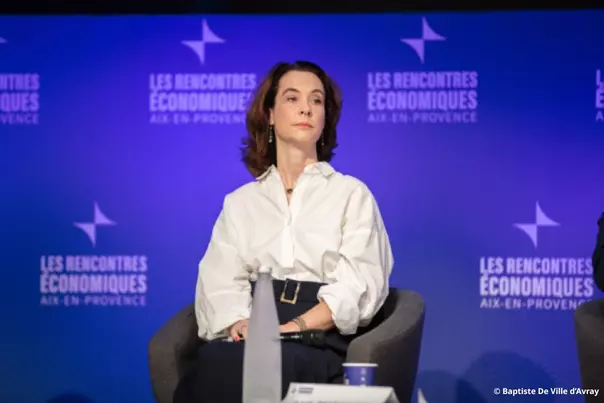
Defense is no longer limited to military equipment. It also depends on a country's ability to guarantee access to resources essential to its functioning. This is the message delivered by Estelle Brachlianoff during the plenary session "What ambition for French defense?" at the Aix Economic Meetings, early July.
"Perhaps to the surprise of some, Veolia is also a defense company," declared the Group's Chief Executive Officer, before clarifying what this means: "Veolia helps build strategic autonomy." This contribution does not consist of manufacturing weapons, but of securing what allows states, industries, and populations to function: water, energy, and critical raw materials.
"The first line of defense is that of resources: securing water supply, securing energy supply, securing the supply of strategic raw materials." Recent conflicts show how much these resources have become major geopolitical stakes. In Ukraine, energy infrastructure was among the first targets of bombardment. In the Middle East, desalination facilities, essential for drinking water supply, have been considered critical infrastructure for several decades. As the global leader in desalination, Veolia operates facilities in several regions of the world where water security is a strategic issue. The Group works with competent authorities to ensure the protection and continuity of these essential infrastructures.
Behind every major conflict, there is also a conflict over access to resources. Securing these resources is an absolutely essential issue
Environmental security, a new component of territorial resilience
Faced with climate upheaval and the scarcity of certain resources, environmental protection is also becoming a security issue. Environmental security consists of preserving the conditions essential to the sustainable functioning of societies: access to water, ecosystem protection, sustainable resource management, and adaptation of infrastructure to new risks.
For Veolia, this approach complements the notion of sovereignty: a resilient territory is one capable of anticipating crises, protecting its resources, and ensuring the continuity of essential services.
From water to critical metals: building European strategic autonomy
Sovereignty also requires mastery of resources necessary for future industries. Critical metals—such as lithium, cobalt, nickel, and copper—are essential to many technologies, particularly in industrial, energy, and defense sectors. Yet Europe remains highly dependent on imports today. Facing this challenge, Veolia is developing solutions to recover these resources from waste materials, particularly through end-of-life battery recycling. This ability to transform waste into new resources supports a dual ambition: accelerating the ecological transition and strengthening European strategic autonomy.
Securing the supply of water, raw materials, and local energy is absolutely key
For Estelle Brachlianoff, critical infrastructure must now be fully integrated into territorial resilience strategies.
The company as a force for social cohesion when it demonstrates its usefulness
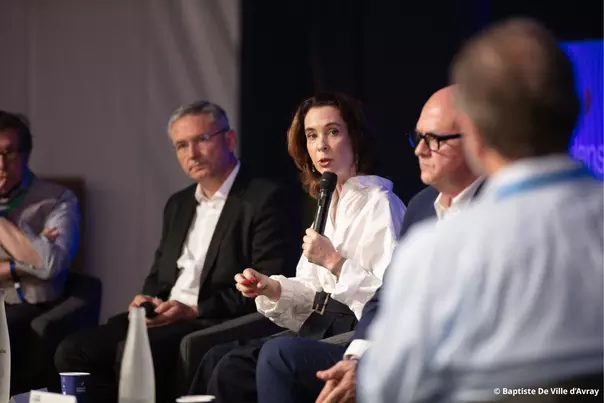
For Antoine Frérot, Veolia's Chairman, a company can contribute to social bonds on one essential condition: that it demonstrates its usefulness to all those who engage with it. The question of corporate usefulness and their contribution to collective resilience has been at the heart of Veolia's commitment for several years: supporting territories in managing essential resources, protecting the environment, and creating lasting value for all stakeholders.
"For a company to contribute to living together, it must be useful, appear useful, and be perceived as useful to many," explained Antoine Frérot during the plenary session "Living together, will salvation come from business?" This usefulness concerns all of the company's stakeholders: employees, customers, shareholders, suppliers, territories, and future generations. According to Antoine Frérot, these stakeholders may have different expectations, sometimes contradictory in the short term. But their shared commitment to the company reflects the same will: to build sustainable value creation together. To achieve this, the company must be able to identify these expectations, measure them, and report on them.
Toward plural performance and more representative governance
For Antoine Frérot, a company's usefulness must be evaluated through plural performance, which combines financial, social, environmental, and societal dimensions. This approach requires setting objectives in each of these dimensions, measuring them, auditing them, and accepting to be evaluated on all these results.
"We need a system of plural performance, because performance has more than one dimension." For Antoine Frérot, if the company serves multiple stakeholders, its decision-making bodies must reflect this plurality. "Performance is plural, usefulness is plural, so management bodies must reflect this plurality." The board of directors can thus play an essential role in better integrating the different perspectives that contribute to the company's sustainable success: shareholders, employees, customers, territories, as well as actors committed to environmental issues and future generations.
A shared ambition: contributing to a more resilient society
In a more uncertain world, the ability of companies to be useful, responsible, and resilient becomes a determining factor in collective stability. Because today, protecting a society does not consist solely of strengthening its military capabilities: it also means guaranteeing its access to essential resources, protecting its critical infrastructure, and preserving the conditions necessary for its functioning.
It is in this sense that resource security, at the intersection of sovereignty, defense, and environmental security, becomes a major strategic issue. Securing water, energy, and critical raw materials, while protecting ecosystems, is an essential condition for national autonomy and resilience.
Tomorrow's defense will therefore not rely solely on military capabilities: it will also depend on the ability to preserve vital resources and guarantee the continuity of essential services. It is from this perspective that Veolia contributes to defense issues by securing the resources essential to the functioning of societies. And this, while reaffirming a strong conviction: sustainable performance depends on companies' ability to meet the major challenges of their time and contribute positively to society.
Key takeaways
1. Resources have become a strategic issue of sovereignty and defense
Water, energy, and critical raw materials are now at the heart of geopolitical balance. Securing their access and availability is an essential lever for territorial, industrial, and population resilience.
2. Critical infrastructure must be protected and made more resilient
Recent crises show that essential civil infrastructure has become a strategic element. Ensuring the continuity of fundamental services—such as access to water or energy—is a condition for collective stability.
3. The circular economy contributes to strategic autonomy
Recycling resources present in waste, particularly critical metals, reduces external dependencies while accelerating the ecological transition.
4. Companies must demonstrate their usefulness to all stakeholders
A company's performance is no longer measured solely through financial results. It must integrate economic, social, environmental, and societal dimensions, and report on its impact to all stakeholders.
5. Governance adapted to new challenges
If corporate usefulness is plural, governance must also reflect this diversity. Involving different stakeholders in strategic discussions helps build more balanced and sustainable decisions.